
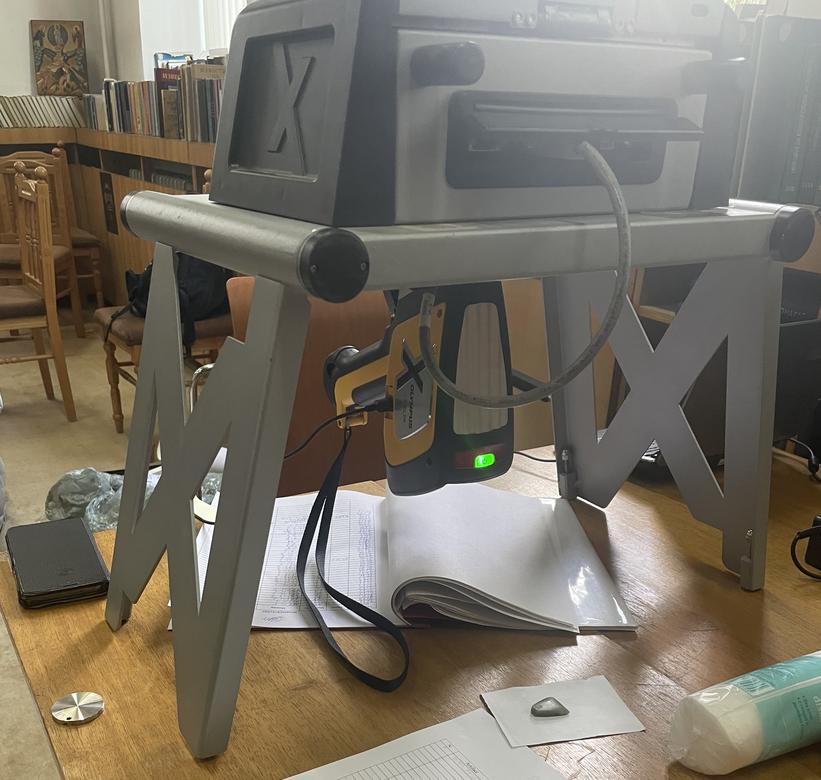
(FIGURE - pXRF in action)
What is pXRF?
Portable X-Ray Fluorescence (pXRF) is a non-destructive analytical technique used to determine the chemical composition of stone. The instrument directs an X-ray beam onto the surface of an object or raw material, exciting atoms in the sample. These atoms then emit fluorescent X-rays that are unique to each element. By measuring these emissions, pXRF produces an elemental profile — a kind of chemical fingerprint — that can be used to characterise the raw material. Because the method does not damage the artefact and can be conducted directly in museums or in the field, pXRF is highly versatile for archaeological applications.
Application in FROM STONE TO HOME
We apply pXRF to both polished stone tools and geological samples collected during our field surveys at potential procurement sites. By building up a comparative dataset of artefact compositions and quarry samples, we can establish baseline signatures for different localities. These baselines provide the foundation for assessing whether a polished stone tool was made from locally available raw material or whether it originated from a more distant source. The portability of the instrument also allows us to extend analyses directly to museum collections, ensuring that even rare or fragile artefacts can be included without risk of damage.
Workflow
Our workflow centers on repeated, standardised measurements to ensure comparability across sites and assemblages. Each artefact or raw material sample is analysed in multiple points to capture variability in the stone’s composition. The resulting data are stored in the project’s open database, where they can be directly compared with data generated from other analytical techniques such as FTIR or LA-ICP-MS. In this way, pXRF provides the broad, non-destructive baseline data against which more detailed analyses can be targeted.
Challenges and Solutions
While pXRF is fast, portable, and non-destructive, it has limitations. Surface irregularities, weathering, and patination can sometimes obscure the true chemical composition of a sample. To mitigate these issues, we use repeated measurements, careful surface selection, and — where possible — complementary data from other analytical methods. This multi-method approach ensures that pXRF results remain reliable and interpretable in the context of provenance research.
Outcome
pXRF offers a rapid and effective way to fingerprint the elemental composition of polished stone tools and raw materials. When combined with geological samples from procurement sites, these fingerprints provide the first step in identifying potential sources. As part of the integrated analytical strategy of FROM STONE TO HOME, pXRF is invaluable for building provenance baselines and for mapping prehistoric resource procurement and exchange networks across the Aegean.