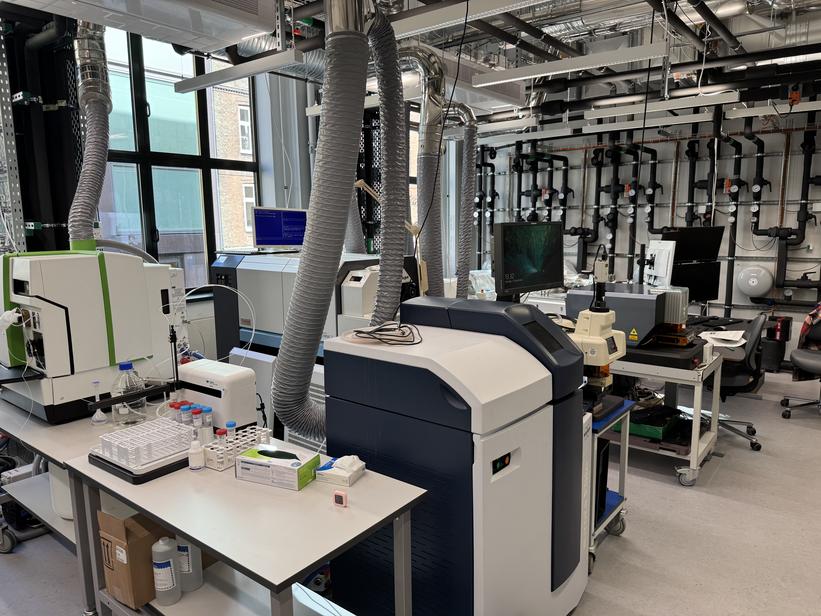
(FIGURE - The lab at GEUS)
What is LA-ICP-MS?
Laser Ablation Inductively Coupled Plasma Mass Spectrometry (LA-ICP-MS) is a high-precision technique that can measure trace elements and isotopes in the minerals included in stone. A focused laser beam ablates a microscopic amount (um size) of the material, which is then ionized in the plasma region and analysed by an ICP mass spectrometer. The resulting data provide detailed elemental profiles and isotopic information that are used to fingerprint the origin of the stone material, making the method a powerful tool for provenance studies.
Application in FROM STONE TO HOME
We apply LA-ICP-MS to both polished stone tools and geological samples collected from procurement sites. By combining Automatic Quantitative Minerallogy (AQM) mapping using a scanning electron microscope (SEM) mapping with LA-ICP-MS spot analyses, we generate paired datasets of petrographic, geochemical, and geochronological information. This integrated workflow allows us to fingerprint the origin of polished stone tools with high precision.
The workflow is coordinated using a state-of-the-art approach developed at GEUS. Using a sample holder fitting all analytical instruments, we first we use the SEM imaging to precisely map the mineralogy and texture of the stone material. Based on these selected minerals and their point coordinates are transfered with micron-scale accuracy (≤5 µm) to the laser ablation sample stage and analysed. This ensures that the obtained chemical and isotopic data are directly linked to specific minerals and textures of the material, thus enhancing a reliable source identification.
Challenges and Solutions
Because laser ablation offers no direct visual feedback, accurate transfer of fixed (or fiducial) points from SEM mapping is essential. The multi-fit sample holder provides reliable, repeatable reference points, thus ensuring integration of data across instruments and sessions. While LA-ICP-MS is minimally destructive, the scale of ablation is at micrometer level, preserving the integrity of the artefacts. However, in some cases it can be necessary to take a small chip sample from the artefact in order for it to fit into the instrumentation.
Outcome
This workflow creates robust set of multi-parameter geochemical and isotopic fingerprints. When artefacts share the same trace element and isotopic date, characteristica comparable to the quarry samples, we can link them with high confidence to their geological source. This method, therefore, provides a crucial foundation for mapping prehistoric resource procurement, exchange networks, and the circulation of rare raw materials across the Aegean.